I am saying it loud and proud.
“Marketing is not a function. It’s the management of the end-to-end customer experience under real-world conditions.”
Because “real-world conditions” is the part most organisations politely ignore.
Customer experience doesn’t happen in a vacuum.
It happens while prices rise, budgets tighten, and switching costs fall, trust in institutions wobbles and as AI reshapes discovery and decision.
This constant shift creates a real time adjustment map, making regulation, media narratives, and social proof rewrite “truth” in the moment for relevance.
Treating marketing as “comms + campaigns” in that environment is like treating navigation as “the steering wheel.” Useful, but not the system.
What’s less written about (and far more commercially relevant) is this:
Marketing is the organisation’s external-force interpreter. It is the discipline that translates shifting context into customer behaviour, and customer behaviour into operating decisions.
That is why marketing belongs in strategy, operating model design, risk management, and transformation and not as a service department waiting for a brief.
The evidence to support: customer experience is end-to-end, cross-functional, and shaped by forces you don’t control
1) Customers don’t experience “touchpoints.” They experience journeys. Organisations love optimising individual moments (“our website CSAT is up!”) while missing the end-to-end reality: customers judge you on the whole journey, not isolated interactions. Focus on key moments that matter as a starting point but work on the end to end journey for true scale and trust.
2) Great CX requires an operating model, not a poster. When companies take customer experience seriously, they rewire decision rights, governance, capabilities, and incentives – i.e., the operating model. That’s not “marketing activity.” That’s organisational design.
3) The experience is shaped by “external touchpoints” you don’t own. Internal obsessing about owned platforms is futile. Peer reviews, social platforms, comparison sites, reputation signals, macro context – these materially affect perceived experience and intent. Research explicitly separates brand-owned vs social/external touchpoints and shows why that distinction matters.
Fish where the fish are. Don’t expect to draw them to you.
4) Trust has become a purchase criterion, not a brand nice-to-have. Edelman’s research shows trust sits alongside cost and quality in purchase decisions – and that expectations of brands are increasingly personal and contextual (“make me feel/look good,” not just “do good”).
5) CX is a competitive advantage lever – and leaders are always accordingly. Deloitte’s CX research underscores the increasing emphasis on embedding CX structurally and measuring its impact as a driver of advantage.
Myth-busting: the five beliefs holding marketing back
Myth 1: “Marketing is a comms function.”
Reality: Marketing is the discipline of commercial sensemaking: insight → proposition → experience → growth. Campaigns are outputs, not the job.
Myth 2: “Customer experience belongs to service / ops / digital.”
Reality: CX belongs to the organisation. Marketing’s role is orchestration ensuring the experience is coherent across channels, time, and context.
Myth 3: “We can’t control the external environment, so don’t overthink it.”
Reality: You can’t control the weather, but you can build a better forecast and stop sailing straight into storms.
External forces shape demand, trust, and switching behaviour. Ignoring them is a strategic failure, not “focus.”
Myth 4: “Retention is a loyalty programme problem.”
Reality: Retention is experience + value + relevance. WARC’s work challenges lazy retention thinking and pushes toward capability and engagement loops, not points schemes.
Myth 5: “Marketing ROI is impossible to prove.”
Reality: You can measure what matters when you stop measuring what’s easy. Loyalty leaders (often tracked via NPS/experience measures) outperform peers materially in revenue growth.
The sharper angle: marketing as “Customer Reality Management”
Here’s the uncomfortable truth most businesses avoid and therefore fail or flatline in their growth:
“The customer’s reality is shaped more by what happens around your brand than what you say about your brand.“
That means modern marketing is not persuasion. It’s reality management.
Monitoring external signals (economic pressure, trust shifts, competitive claims, channel disruption) predicting how those signals change behaviouradjusting proposition, experience, and communication accordingly feeding that back into product, service, pricing, and governance
Do this well and marketing becomes a growth engine. Do it badly and marketing becomes a design studio with a dashboard. And that is on the leaders heads not the team delivering.
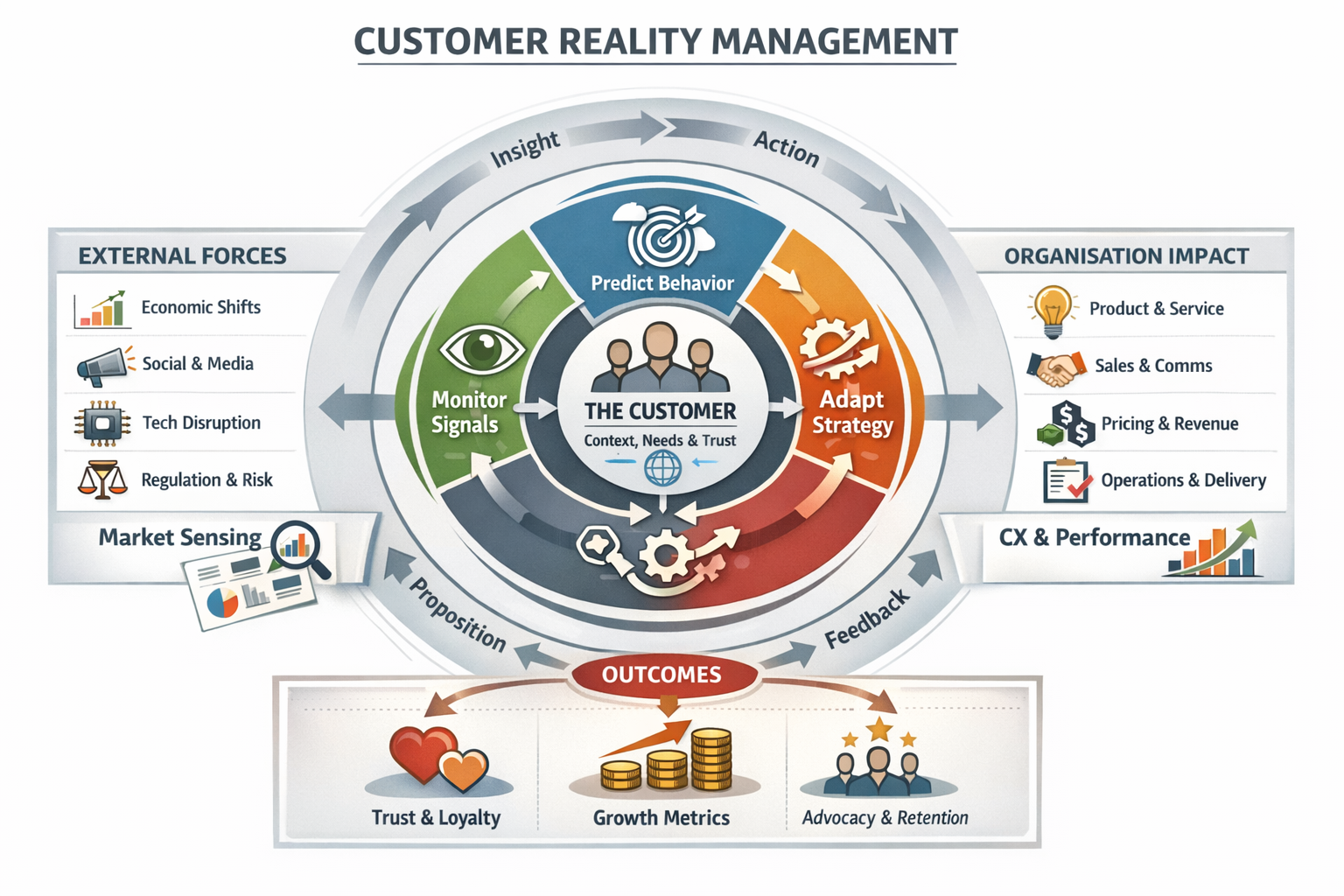
5 steps to move marketing forward for growth
1) Build a “market sensing” capability (not just reporting) Create a lightweight but disciplined system that synthesises:
💡customer insight (qual + quant)
💡competitive intelligence trust/reputation signals and macro forces impacting demand
Treat it as an executive input, not a marketing newsletter.
Suggested Output: a monthly “Customer Reality Brief” with implications and decisions required.
2) Re-define marketing’s scope: from funnel manager to journey owner
Shift language from “campaign performance” to journey performance: acquisition → onboarding → value realisation → renewal/retention → advocacy
The end-to-end journey is where perception is formed.
Suggested Output: 3–5 priority journeys with owners, baselines, and improvement backlogs.
3) Upgrade the operating model (roles, decision rights, governance)
If you want cross-functional CX, you need cross-functional design: decision rights (who can change what, when?) shared KPIs across marketing/sales/service/product
Practice agile ways of working around journeys, not functions. CX excellence requires operating model choices and trade-offs.
Suggested Output: a simple board level “journey governance” cadence (weekly exec blockers, monthly performance, quarterly strategy).
4) Treat trust as a growth KPI, not a brand slide
Trust now behaves like a commercial variable.
Track and manage it like one:
📏expectation gaps (what customers believe vs what you deliver)
📏reassurance architecture (proof, transparency, consistency)
📏reputation risk signals (misinformation, social amplification, complaint velocity)
Data shows trust directly influences purchase decisions.
Suggested Output: a trust dashboard tied to churn, conversion, and complaint drivers. A trust equity tracker.
5) Modernise measurement: link experience signals to financial outcomes
🛑 “marketing metrics theatre.”
Start connecting: journey friction → conversion losson boarding quality → retention liftservice failures → brand trust erosion → switching intent
Bain’s loyalty research highlights the economic value of experience and advocacy leadership.
Suggested Output: 3–5 causal KPI chains that the CFO won’t roll their eyes at.
Closing this out with a challenge to the reader
If your marketing team disappeared tomorrow, would customers notice?
If the honest answer is “they’d still get the same experience,” you don’t have a marketing function – you have a production team.
But if marketing is truly leading insight, orchestrating journeys, and translating external forces into commercial action – customers would notice immediately.
And so would your numbers.

Leave a comment