(and Why the Customer Journey Cares)
For years, business development and marketing have been treated like distant relatives. Same family, shared interests, but rarely seen in the same room without a bit of tension. That way of thinking is quietly dying, and not a moment too soon.
Across boardrooms, NHS supplier briefings and LinkedIn comment threads, the conversation has shifted. Growth is no longer about who shouts loudest at the top of the funnel. About who closes in that decision making moment. It is about who understands the full customer journey best and designs relationships that deliver for that audience and last.
Having spent much of my career selling and marketing into healthcare, particularly the NHS, this shift feels overdue. Long buying cycles, multiple stakeholders, governance heavy processes and an absolute intolerance for fluff have a way of sharpening your thinking. You learn quickly that disconnected marketing and business development do not just slow growth, they actively damage trust. It is why, in almost all healthcare models I have worked in, the business development team is part of Marketing. Because traditional ‘selling’ doesn’t work.
Below are three of the strongest conversations shaping how business development and marketing now come together, and why customer journey and customer relationship management sit firmly at the centre.
CRM has grown up and joined the strategy table
CRM used to be the system you updated on a Friday afternoon, if you remembered. Today, it is the backbone of how modern organisations understand, serve and grow their customers.
The most effective teams now use CRM as a shared intelligence layer across marketing, sales, account management and service. It tells you not just who your customers are, but how they behave, what they care about and where relationships are strengthening or quietly fraying. The rich insight used to create compelling messaging is embedded in the CRM not lying in a forgotten PowerPoint.
In healthcare, this is critical. NHS organisations do not buy on impulse. They assess, compare, pilot, re-evaluate and benchmark continuously. A well run CRM brings that complexity into focus. A poorly run one turns it into noise.
When business development and marketing work from the same customer truth, conversations improve, handovers are cleaner and the customer feels understood rather than processed.
Artificial intelligence is making journeys smarter, not noisier
AI has moved well beyond novelty. The most interesting use is not content generation, but experience sequencing. In plain terms, it helps teams work out what should happen next for each customer.
This matters because customer journeys are not linear. Particularly in B2B and healthcare, progress is often circular. A stakeholder changes role. A budget cycle resets. A new clinical priority appears. AI supported CRM helps teams respond with relevance rather than repetition.
Done properly, this does not feel automated to the customer. It feels considered. The right information arrives at the right moment, and unnecessary contact quietly disappears. That is where business development benefits. Fewer wasted conversations. Better prepared meetings. Relationships that move forward because they respect context.
Marketing is no longer a front end function
One of the most damaging myths still hanging around is that marketing’s job ends at acquisition. In reality, the most valuable work often happens after the contract is signed.
Customer journey thinking now spans awareness, consideration, onboarding, adoption, value realisation, renewal and advocacy. Marketing plays a role in all of it, from setting expectations early to reinforcing value long after implementation. Think the McKinsey model that shows the cycles of a customer journey, this is not a linear path.
In NHS facing roles, this is especially powerful. Credibility is built over time. Consistent messaging, evidence based storytelling and clear articulation of outcomes all support business development by reducing friction and shortening future decision cycles.
When marketing supports the full lifecycle, business development becomes less about persuasion and more about partnership.
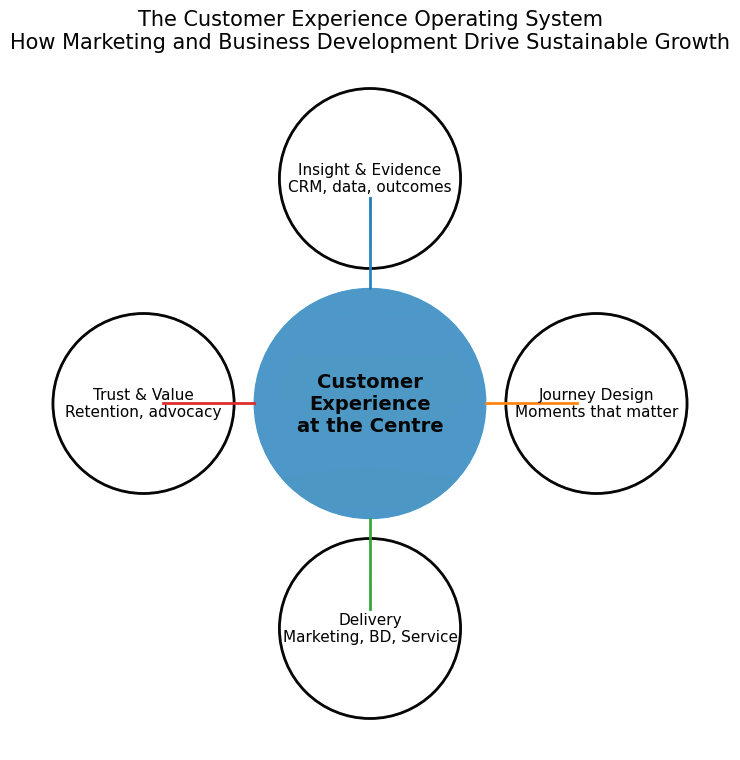
What this means in practice
If marketing and business development are still operating in siloes, customer experience will suffer. So will growth.
CRM should be treated as a strategic asset, not an admin tool. It should inform decisions about where to invest time, how to tailor engagement and when to intervene.
Customer journeys should be designed deliberately, with clear ownership across teams. Every touchpoint either builds trust or erodes it.
And perhaps most importantly, organisations should stop measuring success purely by leads and start measuring it by relationship strength, retention and advocacy.
Key takeaways
🔐CRM is no longer optional infrastructure. It is the shared truth that aligns teams and improves decision making.
🔐AI works best when it reduces noise and increases relevance. Smarter journeys beat louder campaigns every time.
🔐Marketing across the full customer lifecycle strengthens business development by building confidence, not pressure.
🔐In complex environments like healthcare and the NHS, joined up thinking is not a nice to have. It is essential.
If growth is the goal, then experience is the route.
And business development and marketing need to walk it together.

Leave a comment