Innovation Doesn’t Sit in a Department. It Sits in Your People
The problem: We say we want innovation. We manage for control.
Spend any time in a leadership team and you’ll hear the same refrain:“We need to innovate.” And yet, many organisations are structured in a way that makes innovation almost impossible.
Layers of approval.
Risk-averse decision making.
Functional siloes.
Performance measures that reward predictability over progress.
It is no surprise then that while over 70 percent of executives say innovation is a top driver of growth, the majority admit they are not confident in their ability to deliver it. The issue is not a lack of ideas. It is a lack of environments where ideas can survive.
In my experience, particularly in complex sectors like regulated industries, healthcare and NHS-facing organisations, the instinct to control is even stronger.
Governance matters.
Accountability matters.
But somewhere along the line, control becomes the objective rather than the guardrail.
And that is where innovation quietly disappears.
The reality: Innovation is a people management outcome
Innovation is often treated as a strategy, a budget line, or a transformation programme.In reality, it is a by-product of how you lead your people.
If your teams feel:
safe to challenge
clear on direction
trusted to act
supported when things do not go to plan
…innovation follows.
If they feel:
second guessed
over-managed
unclear on priorities
punished for failure
…innovation stalls.
This is not theoretical.
Leadership behaviour directly shapes how teams think, collaborate and perform.
And importantly, innovation is rarely top-down. It is grassroots.
It sits in the people closest to the customer, the product, and the problem.
Your job as a leader is not to come up with all the ideas. It is to create the conditions where the best ideas surface and move.
The shift: From managing activity to enabling outcomes
The most effective leaders I have worked with, and aimed to be, make a very deliberate shift:
They stop managing what people do and start enabling what people achieve.
That sounds simple.
It is not.
It requires:
clarity of direction
discipline in prioritisation
and a willingness to let go of control in the detail.
There is a growing body of evidence that empowered teams make better decisions and solve problems faster, but only when leaders set the right boundaries and expectations.
Too much control, and you create dependency.
Too little structure, and you create confusion.
The balance is where leadership earns its keep.
The role of the manager: From gatekeeper to catalyst
Good managers do not sit in the middle of everything. They remove themselves as the bottleneck.
They act as:
Translators – connecting strategy to day-to-day work
Enablers – removing friction, not adding it
Coaches – building capability, not dependency
Connectors – ensuring functions work as one system
In high-performing organisations, leaders are not the source of all decisions. They are the architects of how decisions get made.
That distinction matters.
Because when decision-making is pushed closer to the work, speed increases, ownership strengthens, and innovation becomes part of how the business operates, not something it occasionally attempts.
The cultural truth: You get the behaviour you tolerate
Culture is often discussed as if it is intangible. It is not.
It is built, daily, through what leaders:
reward
ignore
challenge
allow
Research consistently shows that strong, aligned cultures reduce friction and improve performance significantly.
If a team member takes a considered risk and it fails, what happens next defines your culture.
If the response is blame, you have just shut down ten future ideas.
In NHS and healthcare environments, where scrutiny is rightly high, this balance is even more important. You need rigour without fear. Governance without paralysis.
Space to fail safe.
That is leadership.
The outcome: Innovation becomes a system, not an initiative
When people management is done well, something shifts.
Innovation stops being a campaign or a workshop.
It becomes:
how teams solve problem
show functions collaborate
how customer experience improves
how growth is sustained
Organisations that invest in people development and performance are significantly more likely to outperform their peers financially.
Not because they tried harder.
Because they built a system that works.
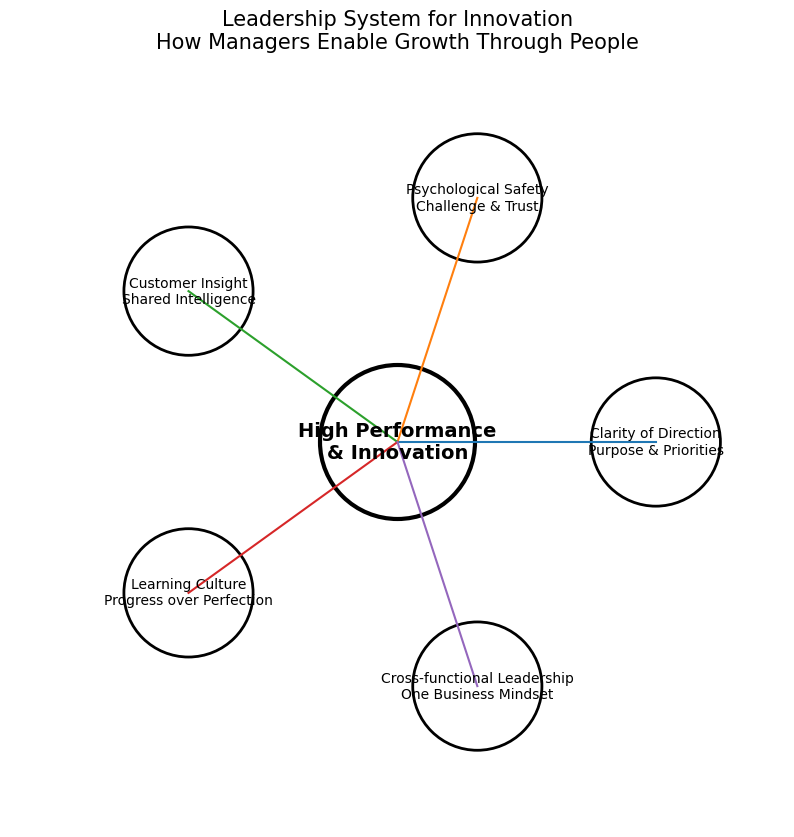
Five takeaways to drive high performance and innovation
1. Set direction, then get out of the way
Clarity removes hesitation. Autonomy drives momentum. Leaders should define the “what” and “why”, then trust teams with the “how”.
2. Build psychological safety without lowering standards
High performance and safety are not opposites. The best teams expect excellence and allow challenge.
3. Treat CRM, insight and customer feedback as shared intelligenceInnovation improves when teams are grounded in real customer experience, not internal assumptions.
4. Reward learning, not just outcomesIf success is the only thing recognised, people will stop taking intelligent risks.
5. Lead across functions, not within themInnovation happens in the gaps between teams. Strong managers connect, align and simplify across the business.
Final thought
If you want innovation, do not start with a programme.
Start with your managers.
Because ultimately, growth is not driven by strategy documents or transformation plans.
It is driven by people.
And people perform best when they are trusted, clear, and properly led.

Leave a comment