Blog by Mhari
HealthTech SaaS marketing is entering a more demanding phase. I am working with a scaling software company through my help to grow mentoring scheme and am sharing some of what I am mapping to help them succeed.
Search
Search is no longer a simple gateway to your website. With AI Overviews, generative search, and zero-click behaviour becoming the norm, buyers are increasingly consuming, comparing, and forming opinions before they ever engage directly with your brand. At the same time, AI is transforming how marketing teams operate moving from predictive analytics to automated content generation and real-time optimisation.
On the surface, this looks like progress.
In reality, it is exposing a deeper issue. That is that many HealthTech SaaS marketing strategies are built for a world that no longer exists. This actually applies to a lot of search not just for SaaS.
The Shift: Your Brand Is Experienced Before It Is Visited
Historically, digital marketing focused on driving traffic. Rank well, attract clicks, convert leads. That model is now under pressure.
Search engines and AI assistants are increasingly summarising answers, surfacing insights, and shaping buyer perception within the platform itself. Google’s own guidance confirms that AI-powered search experiences prioritise helpful, people-first content, often reducing the need for users to click through to individual sites.
Your expertise must stand up to interpretation, summarisation, and comparison and not just presentation.
For HealthTech SaaS brands, where complexity and credibility are non-negotiable, this raises the bar significantly. Visibility alone is no longer enough. You need clarity, substance, and proof.
The AI Paradox: More Capability, Less Differentiation
AI is undeniably improving how SaaS marketing functions:
Predictive lead scoring and pipeline forecasting
Scalable content production
Customer health modelling and churn prediction
Real-time campaign optimisation
These capabilities are now becoming standard. Which creates a paradox.
If everyone has access to the same tools, then AI alone cannot be your competitive advantage.
The differentiator has to sit elsewhere:
Strategic judgement
Market understanding
Customer insight
Commercial alignment
In HealthTech, this is amplified by the complexity of buying groups. Clinicians, procurement teams, finance leads, and operational stakeholders all bring different priorities, risk thresholds, and definitions of value. No algorithm resolves that on its own and it needs enriched by insight to enable next best action.
Trust Is Not solely a Brand Metric. It Is a Buying Mechanism
Research from Edelman consistently shows that trust directly influences health-related decision-making, particularly in environments where misinformation, risk, and competing narratives are present.
For SaaS providers, this has clear implications:
Claims must be evidenced, not asserted
Messaging must be consistent across channels and stakeholders
Credibility must be built over time, not manufactured in disconnected campaigns
In a zero-click world, trust is often formed before direct engagement. Which means your reputation is shaped in environments you do not fully control. That makes precision in both thinking and execution essential.
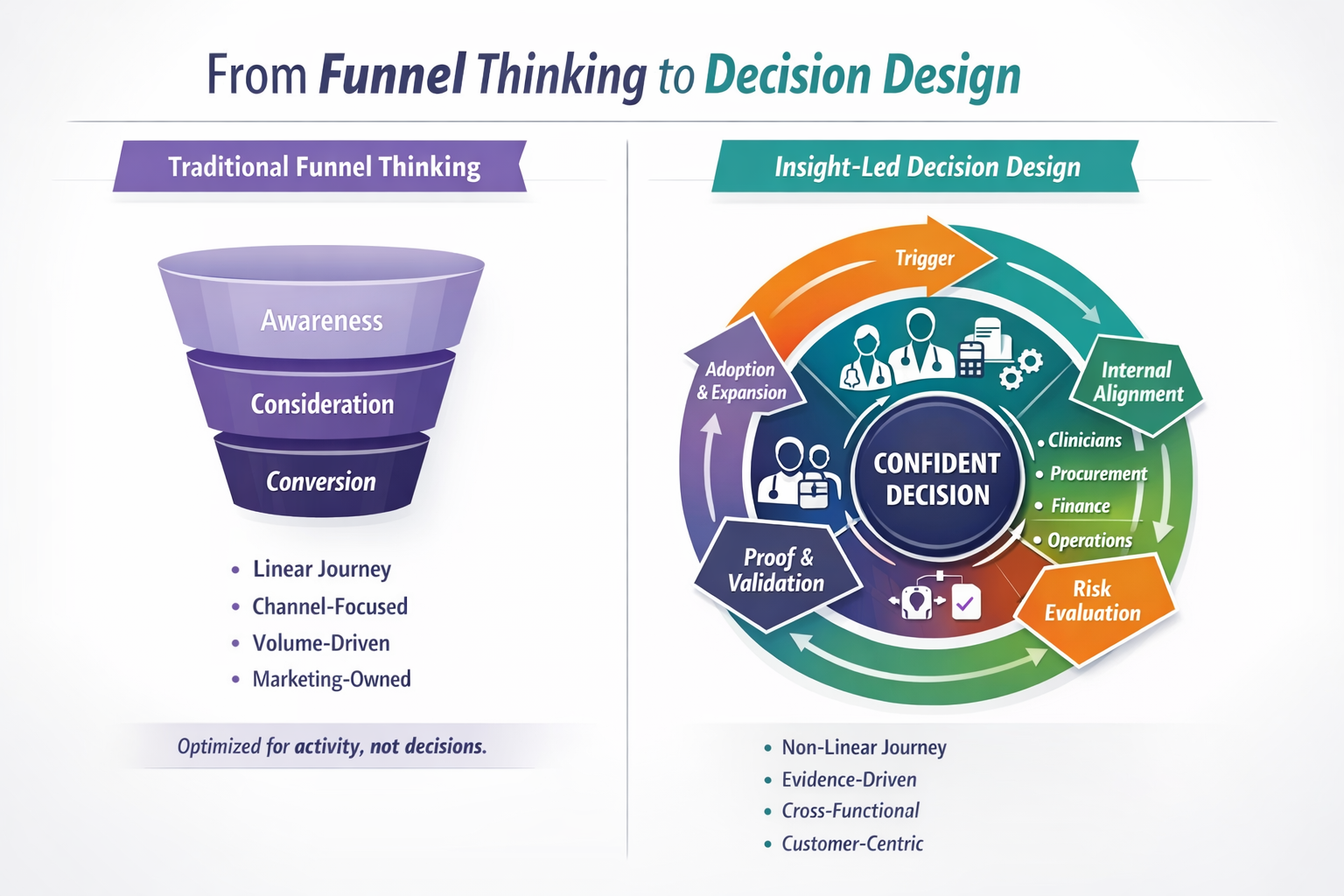
From Funnel Thinking to Decision Design
One of the most persistent limitations in SaaS marketing is over-reliance on funnel models. Funnels describe activity. They do not fully explain decisions. Research from McKinsey highlights the shift toward hybrid B2B buying journeys, where customers move fluidly between digital and human interactions, selecting channels based on convenience, confidence, and complexity.
Buyers will self-educate extensively before engaging
Human interaction remains critical at moments of risk or uncertainty
The overall experience, not just the message, drives conversion
The most effective organisations are responding by moving beyond funnel management and toward decision design.
Ask these questions:
What triggers the need?
What risks are being assessed internally?
What evidence reduces friction at each stage?
Who needs to be aligned before a decision is made?
This is where marketing, sales, product, and customer success converge. The single view of customer journeys.
SaaS Growth Reality: Acquisition Is Only the Start
MQLs, demos, and pipeline volume are important. But they are not sufficient indicators of sustainable growth. McKinsey’s analysis of B2B SaaS companies highlights the importance of net revenue retention (NRR) as a driver of valuation and long-term performance. The strongest businesses are not just acquiring customers, they are expanding, retaining, and deepening value over time.
Shift your thinking:
From campaign thinking to lifecycle orchestration
From lead generation to customer value creation
From short-term conversion to long-term confidence
5 Key Takeaways
1. Design for zero-click reality
Your content must deliver value within platforms, not rely on driving traffic out of them.
2. Optimise for interpretation, not just ranking
In a GEO-driven world, clarity and structure matter as much as visibility.
3. Build trust through evidence
Credibility is earned through consistency, proof, and transparency not positioning.
4. Map decisions, not just journeys
Understand the internal dynamics of buying groups and design accordingly.
5. Focus on lifecycle value
In SaaS, retention and expansion are as critical as acquisition, often more so.
Further reading if useful for you
Google Search Central – AI features and guidance on helpful, people-first content
Edelman – Trust Barometer Special Report: Health (2025)
McKinsey – The Future of B2B Sales: The Big Reframe
McKinsey – Winning B2B Customers in Technology and Telecommunications
McKinsey – Net Revenue Retention and Growth in B2B SaaS

Leave a comment