(Or: how to grow without turning your business into a very expensive mess)
What scaling actually means (and where most get it wrong)
Academic and industry research tends to agree on three scaling pathways:
Scaling out – more customers, more markets, more products
Scaling up – deeper value chain integration, partnerships
Scaling deep – capability, culture, and learning transformation
Most SMEs obsess over the first. The successful ones balance all three
Case Study Lens: What success actually looks like
Grind
Pivoted from physical retail to ecommerce & subscriptions
Achieved 50x subscription growth in months
Built data visibility (LTV, attribution) as a scaling engineTranslation
They didn’t just sell more coffee. They built a repeatable revenue system
Purdy & Fig
Focused on premium positioning & quality control
Expanded distribution while maintaining brand integrity
Leveraged niche differentiation rather than mass dilution
They scaled value, not just volume
The 17 Must-Do Focus Areas for Scaling (Without Losing Your Soul or Margin)
1. Ruthless clarity on your growth model
Are you scaling volume, margin, or valuation? You cannot optimise all three simultaneously. Well actually you can, but only if you have dedicated teams on each and a diverse brand portfolio. And SMEs tend not to.
2. A repeatable revenue engine (not campaigns)
Grind’s subscription model is the blueprint.
If revenue resets to zero every month, you’re not scaling, you’re surviving.
3. Customer lifetime value (LTV) as your north star
Scaling without LTV visibility is just accelerated guesswork.
4. Product portfolio discipline
This one comes from personal pain. Every founder wants to keep everything in their portfolio.
More products ≠ more growth
It usually means:
diluted margins
confused positioning
operational drag
5. Brand as a commercial asset (not decoration)
Strong brands reduce:
CAC – cost of acquisition
price sensitivity -not discounting 100% of the time
churn – saliency buys loyalty
Weak brands require constant discounting. You know which one scales better.
6. Data infrastructure before scale
UK SME research consistently shows data capability drives:
productivity
forecasting
innovation
Scaling without data = flying blind, faster
7. Channel strategy (diversified, not distracted)
Grind expanded retail to ecommerce, then to subscriptions
Each channel had a role. Not just “we should be on TikTok.”
8. Operational scalability (the unglamorous but crucial bit)
If fulfilment, supply chain, or service breaks under pressure you don’t have growth, you have reputational debt
9. Quality control systems
Scaling amplifies your flaws. Purdy & Fig’s discipline here is exactly why they retain brand equity.
10. Financial control and cash discipline
Scaling kills businesses through working capital gaps and over-investment in growth
Growth without cash = vanity and theatre
11. Talent architecture (not just hiring more people)
You need:
builders (early stage)
operators (scale stage)
Most SMEs hire clones of themselves. Then wonder why nothing changes.
12. Leadership maturity
Scaling businesses fail when founders:
won’t delegate
won’t evolve
won’t let go
Brutal, but accurate
13. Partnerships and ecosystem leverage
Scaling up often comes through:
distribution partnerships
supply chain integration
strategic alliances
No SME scales alone
14. Customer experience as a growth lever
Not a hygiene factor. A differentiation engine. Retention balanced with acquisition.
15. Technology as an enabler, not a vanity purchase
CRM, automation, analytic. They are only valuable if they change behaviour
16. Governance and decision discipline
As you scale:
speed decreases
complexity increases
communications reduce in effectiveness
Without governance, chaos wins
17. Cultural scalability (the one most ignore)
Scaling “deep” means embedding:
learning
adaptability
accountability
Otherwise growth plateaus the moment pressure hits
Final Thought (and a small reality check)
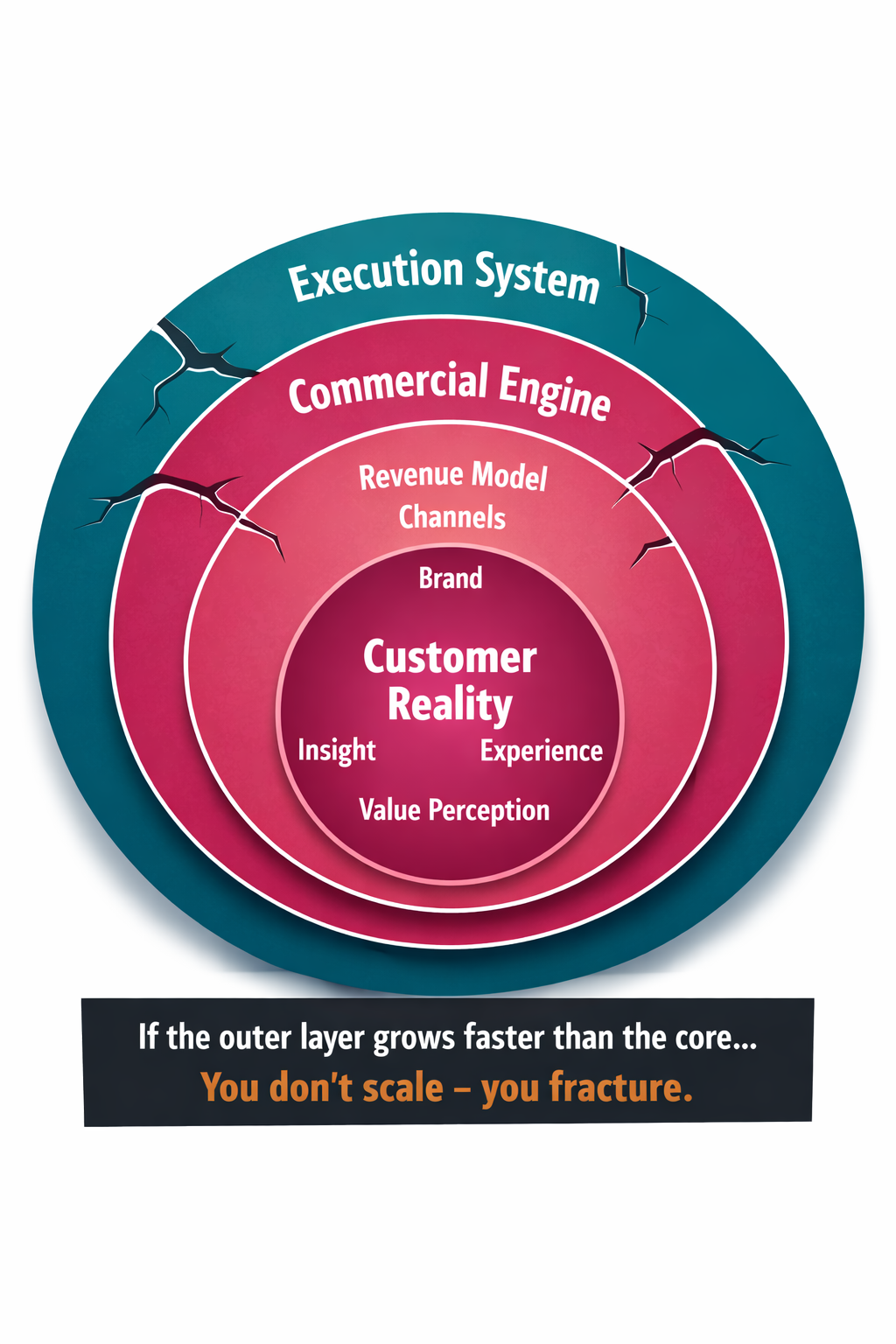
Most SMEs don’t fail because of lack of effort. They fail because they try to scale everything at once. The winners? They scale what works, protect what makes them valuable, and build a culture and systems that make growth feel… almost boring.
(Which, in business, is usually a very good sign.)

Leave a comment