There is a moment in every business where the numbers stop behaving.
Demand softens. Customers hesitate. The gap to target gets bigger with less opportunity coming in. And what once sold easily now requires explanation.
This is not failure. It is the market moving.
The question is whether you move with it.
A pivot is not a rebrand or a campaign. It is a deliberate shift in how you create, deliver, and capture value. This is the true skill of Marketing as a function if you give them space to do this. Portfolio strategy and management are essential.
The difference between businesses that recover growth and those that decline comes down to one thing:
Timing of that shift.
CASE STUDY 1: SHOPIFY — FROM PRODUCT TO ECOSYSTEM
Shopify began as a simple ecommerce tool. As the market matured, that model risked commoditisation. Rather than competing on features, Shopify expanded its role:
– app ecosystem
– integrated payments
– fulfilment infrastructure
They moved from being a tool to becoming infrastructure. The result is a business that scales with its customers, not just to the demand.
CASE STUDY 2: CHEGG — WHEN AI REDEFINES VALUE
Chegg built a strong subscription model around study support. Then generative AI changed expectations. Students no longer wanted static answers. They wanted real-time, conversational support. Demand dropped quickly. Chegg’s response has been to integrate AI and reposition around personalised learning.
The lesson is clear:
AI does not just compete with your product. It changes what “good” looks like.
CASE STUDY 3: ADOBE — KILLING THE MODEL TO SAVE THE BUSINESS
Adobe moved from one-off software sales to subscription. It was an unpopular but bold move. It reduced short-term revenue.
But it created:
– predictable income
– deeper engagement
– higher lifetime value
Now, with AI embedded across its tools, Adobe continues to evolve its value proposition.
CASE STUDY 4: LEGO – SIMPLIFY TO SCALE
LEGO faced declining sales and over-complexity. Their pivot was not expansion, but focus. They reduced product lines, strengthened core systems, and expanded into adjacent value areas like media. They became a brand-led ecosystem rather than a product-led company.
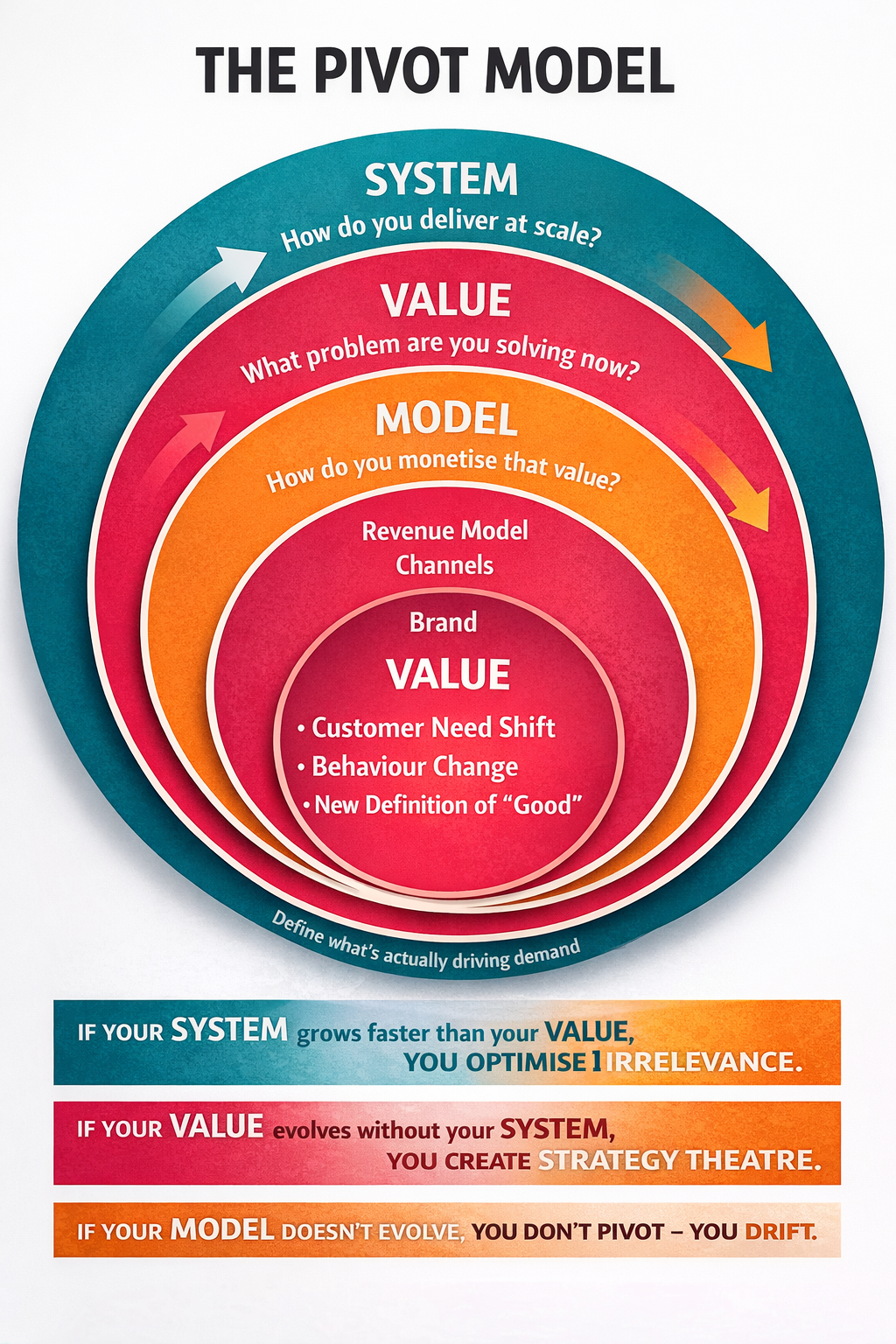
THE PIVOT MODEL
Think of pivoting as three deliberate shifts:
1. VALUE – What problem are you solving now?
2. MODEL – How do you monetise that value?
3. SYSTEM – How do you deliver it at scale?
If any one of these changes, the others must follow.
FIVE PRACTICAL MOVES
This is the bread and butter repeating behaviour of successful businesses.
1. Interrogate your revenue model
2. Follow behavioural data, not lagging sales
3. Be willing to cannibalise your own success
4. Test new models alongside existing ones
5. Align leadership incentives to the future
FINAL THOUGHT
Markets rarely collapse overnight.
They drift. Then they shift. Then they replace you.
The best businesses do not react to change. They anticipate it and move early enough that it looks intentional. That is the difference between decline and reinvention. That is the game of the true marketers.
Further reading if you fancy
McKinsey & Company – Reinventing Growth: How to Transform Your Business Model
Goldman Sachs – Generative AI Could Raise Global GDP
MIT Sloan Management Review – Why Platform Businesses Are Taking Over
Kotter International – Leading Change (John Kotter Framework)
PwC – Global CEO Survey

Leave a Reply