Most marketing teams are playing the wrong game. They focus on grabbing attention only.
We spend an extraordinary amount of time trying to capture attention, improve conversion and take market share from our competitors. We analyse the funnel, sharpen the proposition and debate whether the call to action needs to be moved three centimetres to the left. And be pink. All useful work, within reason. But the brands that create the largest and most enduring opportunities often do something more ambitious. They do not simply persuade people to choose a different product. They help people adopt a different behaviour. They create a new occasion. Remove an old barrier. Make an unfamiliar or shame led action feel normal. Turn specialist knowledge into something people can actually use. Or make a better choice easier to, well, choose, and to sustain. When that happens, demand does not merely move between brands. The category itself can grow.
Persuasion and value propositions may win a sale. But it will cost you more to win the same this year as the year before. Fact. Tackling behaviour change can build a category, grow a category, and sometimes create a new market. That is a more powerful role for marketing, but it also brings greater responsibility. Changing behaviour is not automatically a positive simply because it produces revenue.
More consumption is not always better consumption.
A larger category is not necessarily a healthier category, for its customers or for society. The serious question is not merely whether marketing can change behaviour. It is whether the change creates value for everyone whos behaviours are required to make it work. That is what I call the win triangle or win win win. The Triple Win we called it at JnJ and I think that name holds. Here I share my execution perspective of the model.
The Triple Win model for creating growth is commercially strong, ethically sound and genuinely useful.
Category growth begins beyond the existing customer. Traditional competitive strategy can make the market feel like a fixed pie. Growth means taking a larger slice, usually from somebody else. There is nothing wrong with winning share, I love to see that grow, but that only happens when you have high reach and frequency and consistency. This usually takes a decent chunk of a budget. Brands need penetration, distribution, mental availability and a compelling reason to be chosen. The outcome of this is everyone focuses solely on switching existing buyers between similar offers, and so the category becomes an increasingly expensive fight over familiar demand. Great for agencies, less great for the consumer who is overwhelmed by sameness.
Category growth asks a different question: What would need to change for more people to enter, use or benefit from this market?
Perhaps people do not understand the category. Perhaps the behaviour feels inconvenient, socially awkward or risky. Perhaps the buyer and the end user value entirely different outcomes. Perhaps the product is available, but the system surrounding it makes adoption difficult. This is especially clear in B2B2C and healthcare, where the person using a product may not be the person buying, prescribing, funding or specifying it. A patient may need a better outcome. A clinician needs confidence in the evidence and likelihood of adherence. A commissioner needs an economic case. A provider needs enough sustainable demand to keep investing in the solution. Winning for the patient without winning for the system creates frustration. Winning for the buyer without improving the patient’s experience creates activity without meaningful value. Winning only for the provider may create a short-term sale, but rarely a durable market.
Category growth happens when these interests become connected. The behaviour gap is often the real commercial opportunity. Businesses tend to describe their growth problem in commercial language. Awareness is too low. Leads are poor. Conversion has stalled. Market share is flat. Customers are not sufficiently engaged. Sometimes those are the problems. But more often the commercial problem is only the visible end of a behavioural one. People know exercise is good for them but do not build it into their week. Patients understand that stopping smoking will improve their health but struggle with the immediacy of cravings and the possibility of failure. Facilities teams may recognise the long-term value of energy efficiency but remain constrained by procurement cycles, disruption risk and competing capital demands. Organisations may want better customer data but continue using spreadsheets because changing the system feels harder than tolerating the inefficiency. Information alone rarely closes these gaps. People do not fail to act simply because nobody has supplied enough facts. Behaviour is shaped by friction, habit, confidence, social norms, timing, perceived risk and the immediate environment. The desired outcome may be rational, yet the journey towards it still has to work for a human being living under real-world conditions. This is where marketing moves beyond communication. The marketer’s role becomes understanding what currently makes the desired behaviour difficult, uncertain or unrewarding and then working across proposition, product, service, experience and communication to change that reality. It is less glamorous than “creating a movement”. It is also far more useful.
Behaviour changing marketing examples
Nicorette: growing by making quitting feel possible
In my previous article on B2B2C healthcare marketing, I discussed my experience working with Nicorette and the complexity of growing smoking-cessation support. The category could not grow simply by telling smokers that smoking was harmful. They already knew. The more important behavioural challenge was making each quit attempt feel credible, supported and worth beginning, particularly for people who had tried before and believed that failure meant they were incapable of stopping. That required different but complementary cases for each part of the system. Patients needed a human story that recognised relapse and presented another attempt as progress rather than failure. GPs required confidence in the intervention and in the patient’s likelihood of continuing with it. Procurement teams needed cost modelling and a defensible economic case. The commercial outcome was significant. Our NHS prescribing share grew by 26%. But the mechanism matters more than the number. The category grew because the work addressed the behaviour surrounding the product. It reduced the psychological cost of trying again, increased professional belief and gave the funding audience a clearer value case. The individual gained a more achievable route towards stopping smoking. The shame of failing was removed and failing reframed as part of the cycle that led to successful quitting. The healthcare system gained the potential for better outcomes and lower downstream burden. The provider gained sustainable category demand. That is a Triple Win.
Stoptober: making a difficult individual act feel social
The effectiveness case for Stoptober offers another clear example of behaviour-led growth in smoking cessation. Rather than repeating distant warnings about future ill health, Stoptober created a defined, shared and achievable behavioural challenge: stop smoking for 28 days. That framing mattered. “Quit forever” is psychologically enormous. Twenty-eight days feels more immediate and navigable. A nationwide moment also shifted quitting from a private struggle into a visible social act. Participants were joining others rather than attempting change alone. The initiative reportedly generated 1.5 million quit attempts over four years, with 65,000 more quitters in year four than in year one. The estimated short-term return was £2.85 for every £1 invested. This is an important lesson for commercial marketers. The campaign did not merely communicate the benefits of quitting more loudly. It restructured the behaviour. It gave it a starting point, a duration, social proof and supportive tools. The end user received a more achievable path to change. Public health commissioners gained measurable participation and economic value. Smoking-cessation providers and services benefited from a larger and more engaged population seeking help. Again, the growth came from making the behaviour easier to begin and sustain.
Oatly and Alpro: moving plant-based milk from restriction to mainstream
Plant-based milk provides a useful B2C example because its growth depended on moving beyond the narrow food allergy audiences who originally had to avoid dairy. The behaviour-changing opportunity was not simply persuading vegans or people with intolerances to switch brands. It was making plant-based drinks relevant to people who already consumed dairy and saw no pressing reason to change. Oatly helped make oat milk culturally visible and desirable. Its marketing appeared in places where a younger audience was already spending time, used a deliberately recognisable tone and presented the product as something interesting in its own right, rather than a worthy substitute for people unable to drink “normal” milk. That distinction helped change the social meaning of the category. Meanwhile, Alpro’s approach illustrates the next stage of category development. Once plant-based alternatives moved beyond a niche, the task became making the category easier for mainstream shoppers to understand and navigate. Its packaging and portfolio strategy aimed to reduce shelf confusion and offer products at different entry points, supporting broader recruitment rather than speaking only to an ideologically committed audience. By September 2023, the UK oat milk category was generating more than £231 million in annual sales. Plant-based milk had moved a considerable distance from a specialist restriction category towards an everyday repertoire choice. The end user gained more choice and a product that could fit naturally into an existing routine. Retailers gained incremental category value and broader shopper relevance. Providers gained access to audiences far beyond the original niche. The behaviour changed from “I drink this because I cannot have milk” to “this is one of the drinks I choose”. That shift is how categories become normal.
DP World: changing an industry standard, not just an opinion
The Triple Win is not confined to consumer goods or public health. A particularly strong B2B example comes from DP World’s campaign to change the standard temperature used for transporting frozen food from minus 18°C to minus 15°C. This is category-level marketing in its most strategically interesting form because the objective was not merely to make buyers feel warmer towards the DP World brand. It was to change an established operating behaviour across a complex global system. A three-degree change may sound modest. Across cold-chain logistics, however, changing an accepted technical standard requires evidence, coordination and confidence. Food producers, logistics providers, retailers, industry bodies and regulators all need to believe that the change is safe, operationally workable and economically worthwhile. The proposition connects the interests of the full system. If the evidence supports equivalent food safety and quality, consumers retain the product experience they expect. Buyers and supply-chain operators have the potential to reduce energy use and operating costs. DP World strengthens its relevance as a provider capable of leading industry-wide efficiency and sustainability. This is not traditional B2B promotion. It is market leadership through changing the rules by which the market operates. The APG recognised the work for its strategic response to climate change. More importantly, it demonstrates why B2B category growth often demands more than a campaign. It requires an evidence-backed coalition around a new behaviour. The buyer needs proof. The end user needs protection.The provider needs a viable commercial model. Without all three, an ambitious idea remains a conference presentation.
Introducing the Triple Win how to guide
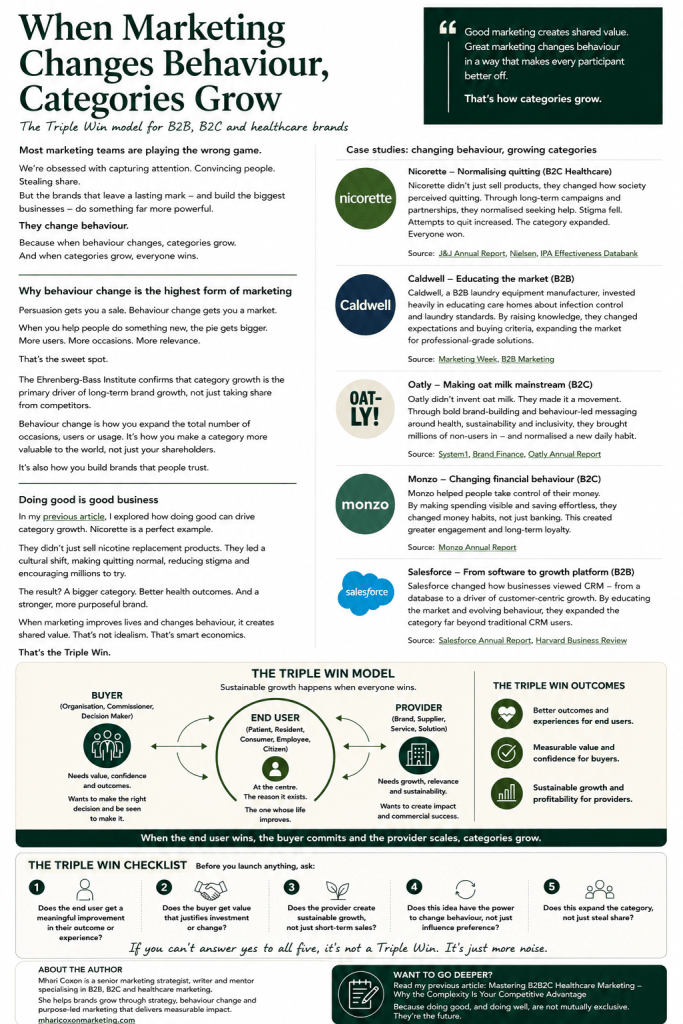
The Triple Win begins with the end user. That end user might be a patient, resident, consumer, employee, service user or citizen. They are the person whose life, health, experience, work or environment should improve because the solution exists. On one side sits the buyer. This may be an individual purchaser, retailer, commissioner, procurement team, employer, healthcare professional or organisational decision-maker. The buyer needs confidence, measurable value and a justifiable reason to act. On the other side sits the provider: the brand, supplier, service organisation or solution owner. The provider needs sustainable demand, commercial relevance and the ability to keep investing in quality, access and growth. All three are connected. If the end user does not benefit, there is no meaningful improvement outcome. If the buyer cannot justify the investment or change, the behaviour will not be funded, specified or supported. If the provider cannot generate sustainable value, the solution will not scale. Good marketing aligns those interests rather than pretending they are the same. That distinction matters. Shared value does not mean every participant wants identical things. A patient may want normality. A clinician may want adherence. A commissioner may want reduced system costs. A provider may want profitable growth. The strategic work is finding the behaviour and value exchange that allows those different objectives to reinforce one another.
The Triple Win is also an ethical test
There is an understandable temptation to treat all behaviour change as marketing success. It is not. Marketing can make people consume more than they need, remain endlessly engaged, misunderstand risk or choose what benefits the seller more than it benefits them. Clever behavioural design can remove useful friction as easily as unnecessary friction. The Triple Win therefore has to be more than a commercial planning model. It is also a governance question.
Would the end user still benefit if they fully understood how the intervention worked?
Is the improvement meaningful, or are we manufacturing dissatisfaction to generate demand?
Does the buyer receive evidence of value, rather than a convenient performance metric?
Can the provider grow without undermining the outcome that justified the proposition in the first place?
And perhaps the most revealing question: If this behaviour became normal across the category, would the result be better for society?
If the answer is no, it is not a Triple Win. It is simply effective execution of increased consumption.
The Triple Win checklist
Before launching a behaviour-changing proposition, campaign or service model, ask yourself these questions:
Does the end user gain a meaningful improvement? Not merely increased awareness or a completed transaction.
What becomes better in their health, experience, confidence, capability, convenience or quality of life?
Does the buyer receive value that justifies action?
Can the person funding, prescribing, procuring or supporting the change see a defensible return, reduced risk or improved outcome?
Can the provider create sustainable growth?
Does the model generate enough commercial value to maintain quality, availability and continued investment, rather than depending on short-lived promotional activity?
Can the desired behaviour be performed in the real world?
Have you considered friction, habit, timing, confidence, social norms, incentives and the environment in which the action must happen?
Does the proposition grow useful demand?
Are you expanding access, occasions or participation in a way that adds value, rather than merely moving existing buyers around or stimulating unnecessary consumption?
Can the outcome be measured across all three parties?
A Triple Win should be visible in end-user outcomes, buyer value and provider growth. Measuring only sales tells you whether something was purchased, not whether the system improved.
Do this to get started on building your Triple win strategy
Choose one priority category, proposition or campaign and stop discussing the audience as a single customer. Write the end user, buyer and provider on three separate pages.
For each one, answer four questions:
- What behaviour needs to change?
2. What makes the current behaviour easier or safer?
3. What does this party risk by changing?
4. What would a genuine win look like for them?
Then place the answers beside one another. You will quickly see where your strategy is relying on one audience to absorb all the inconvenience while another receives most of the benefit. You may discover that the campaign is asking communication to solve a product problem. Or that your value proposition is persuasive for the buyer but almost irrelevant to the person expected to use the service.
That gap is not a messaging issue. It is the work.
Marketing should aim higher than attention share
Marketing has spent years chasing attention. I think we have been aiming too low. The brands that leave the strongest commercial legacy do not merely persuade people to purchase. They make better behaviours more possible, more normal or more valuable. They help people make another quit attempt. They turn a specialist alternative into an everyday choice. They enable an industry to use less energy without reducing the outcome. They connect human benefit with buyer value and commercial sustainability. When behaviour changes, categories can grow. When the end user, buyer and provider all benefit, that growth can endure. And when marketing creates that kind of alignment, it stops being the department responsible for promotion. It becomes a form of leadership.

One response to “When Marketing creates opportunities that Change Behaviour, Categories Grow (And good stuff happens)”
[…] in “When Marketing creates opportunities that Change Behaviour, Categories Grow” (https://mharicoxonmarketing.com/2026/07/11/when-marketing-creates-opportunities-that-change-behaviou…), the central challenge was not that smokers were unaware of the health risks. More information […]
LikeLike